Replace every line segment with four smaller ones. Repeat. The Koch curve has infinite perimeter but encloses a finite area — one of the earliest known fractals.
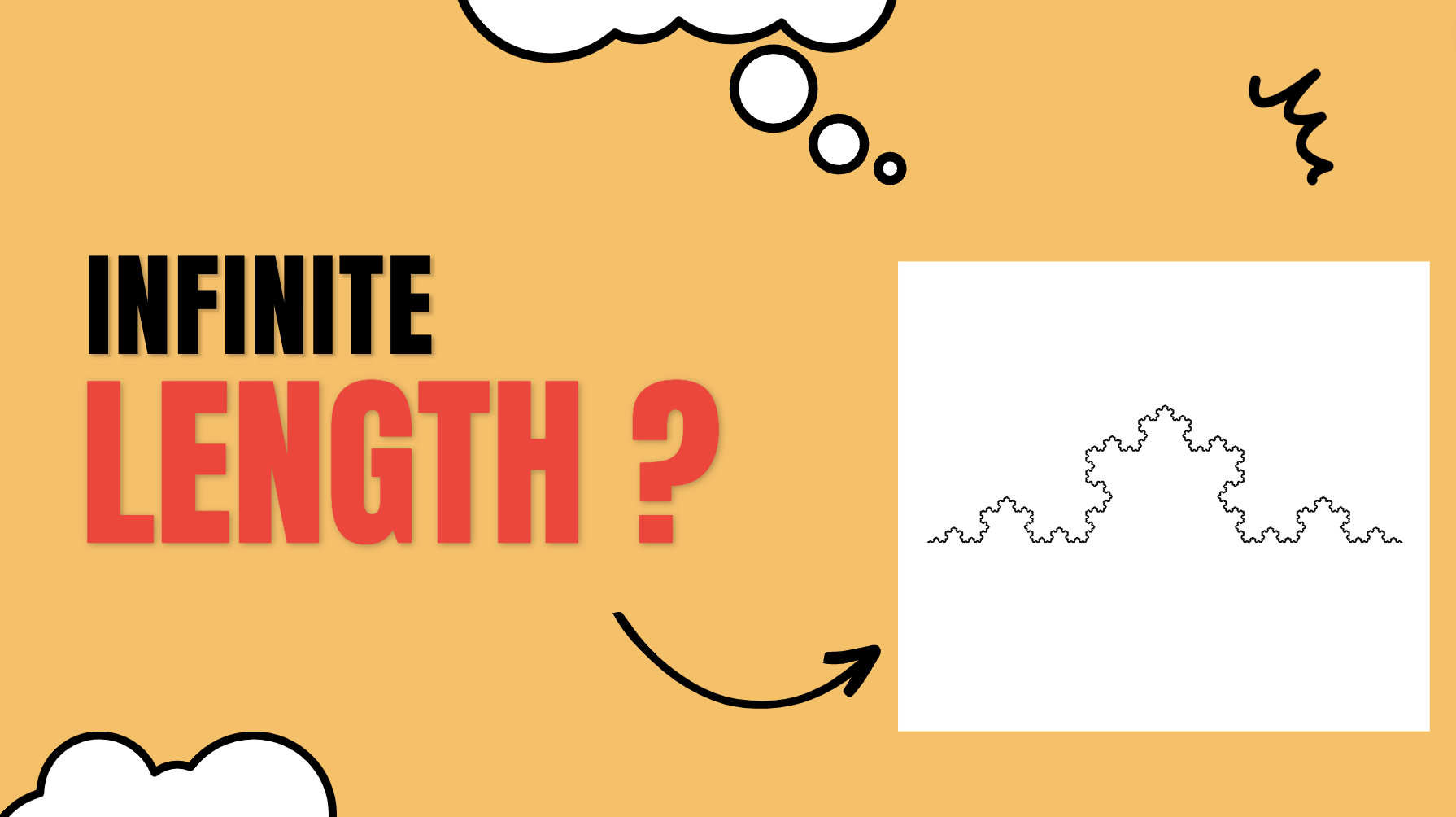
Fractals have long been a subject of fascination in the world of mathematics, captivating mathematicians, scientists, and artists with their mesmerizing properties. One such captivating fractal is the Koch curve, also known as the Koch snowflake curve, which holds immense mathematical significance. Named after the Swedish mathematician Helge von Koch, this intriguing curve not only showcases the beauty of self-similarity but also offers profound insights into the realm of infinite complexity.
Iterative Construction and Self-Similarity: At the heart of the Koch curve lies its iterative construction, a process that unfolds the infinite intricacy of the curve.
We can create a snowflake like pattern using this koch curve. This snowflake pattern is called the Koch SnowFlake. You can read about that in this article
let start, end

const setup = () => {
  createCanvas(500, 500)
  let length = 400;

  start = {
    x: width / 2 - length / 2,
    y: height / 2
  }

  end = {
    x: width / 2 + length / 2,
    y: height / 2
  }
};

const draw = (p5) => {
  background(255)
  kochSnowflake(start, end, currDepth);
}kochSnowflake() is defined below. This is the main function that divides a line segment into four new line segment according to the koch's algorithm.
function kochSnowflake(start, end, depth) {
  if (depth === 0) {
    drawLine(start, end);
  } else {
    let a = { x: start.x, y: start.y };
    let b = { x: start.x + (end.x - start.x) / 3, y: start.y + (end.y - start.y) / 3 };
    let c = { x: start.x + 2 * (end.x - start.x) / 3, y: start.y + 2 * (end.y - start.y) / 3 };
    let d = { x: end.x, y: end.y };

    let v = rotateVector(subtractVector(c, b), -PI / 3);
    let e = addVector(b, v);

    kochSnowflake(a, b, depth - 1);
    kochSnowflake(b, e, depth - 1);
    kochSnowflake(e, c, depth - 1);
    kochSnowflake(c, d, depth - 1);
  }
}

function drawLine(start, end) {
  line(start.x, start.y, end.x, end.y);
}

function subtractVector(v1, v2) {
  return { x: v1.x - v2.x, y: v1.y - v2.y };
}

function addVector(v1, v2) {
  return { x: v1.x + v2.x, y: v1.y + v2.y };
}

function rotateVector(v, angle) {
  let x = v.x * cos(angle) - v.y * sin(angle);
  let y = v.x * sin(angle) + v.y * cos(angle);
  return { x, y };
}One of the most intriguing aspects of the Koch curve is its fractal dimension. Unlike regular geometric shapes, which have integer dimensions (e.g., lines are 1D, squares are 2D), fractals can have non-integer dimensions. The Koch curve's fractal dimension is approximately 1.2618, lying between that of a 1D line and a 2D plane. This non-integer dimensionality reflects the curve's intricate structure, allowing it to fill more space than a typical one-dimensional line, yet not enough to qualify as a two-dimensional shape.
Moreover, the Koch curve exhibits an astonishing paradox. While each iteration adds a finite amount of length to the curve, the total length of the curve approaches infinity as the number of iterations increases. This property defies our intuitive understanding of curves and raises fascinating questions about the concept of infinity in mathematics.
Fractals and Self-Similarity: The Koch Curve is a prime example of a fractal, showcasing the property of self-similarity. At every iteration, smaller parts of the curve resemble the entire curve, albeit at different scales. This characteristic is fundamental to understanding fractals.
Infinite Complexity from Simplicity: The Koch Curve's infinite complexity arises from a deceptively simple rule of iteratively dividing line segments. This illustrates how a basic rule can lead to an infinitely intricate geometric shape.
Fractal Dimension: Unlike regular geometric shapes, the Koch Curve has a non-integer fractal dimension (approximately 1.2618), which reflects its intricate structure and ability to fill more space than a typical one-dimensional line.
Paradox of Infinite Length: Although each iteration of the Koch Curve adds a finite length, the total length of the curve approaches infinity as the number of iterations increases. This paradox challenges conventional notions of curves and raises fascinating questions about infinity in mathematics.
Practical Applications: The Koch Curve has found practical applications in various fields, including computer graphics, data compression, and antenna design. Its self-replicating nature and intricate patterns contribute to generating complex landscapes, reducing file sizes, and improving antenna efficiency.
Educational Tool: The Koch Curve serves as an excellent educational tool to introduce fractals and recursion to learners. Its simple construction process and visually appealing iterations inspire curiosity and further exploration of fractal geometry.
Mathematical Beauty: The Koch Curve exemplifies the elegance and beauty of mathematics, where a seemingly straightforward concept can lead to mesmerizing and unending complexity. It serves as a reminder of the vastness and enigmatic allure of the mathematical universe.
Gateway to Fractal World: Understanding the Koch Curve can act as a gateway to delving deeper into the captivating world of fractals. It provides a foundation for exploring more complex fractal patterns and their applications in various scientific and artistic domains.
Impact on Art and Design: The Koch Curve, with its visually striking iterations, has influenced art and design, inspiring artists to incorporate fractal patterns into their work, creating mesmerizing and visually appealing artwork.
Fractals in Nature: While the Koch Curve is a mathematical construct, fractal patterns akin to it can be found in nature, from coastlines to snowflakes. Understanding fractals helps us appreciate the inherent complexity and beauty found in natural phenomena.
In conclusion, the Koch Curve offers profound insights into the world of fractals and their infinite complexity. It highlights the interplay between simplicity and complexity, challenging our understanding of geometry and infinity. As a powerful educational tool and a source of inspiration for artists and mathematicians alike, the Koch Curve continues to leave a lasting impact on the realms of mathematics, science, and art.
New tutorials, book updates, and behind-the-scenes notes from the studio. No schedule, no spam.