The Julia set is the Mandelbrot's sibling — same iteration, but the constant C sweeps over time. Watch the fractal morph through an infinite family of shapes.
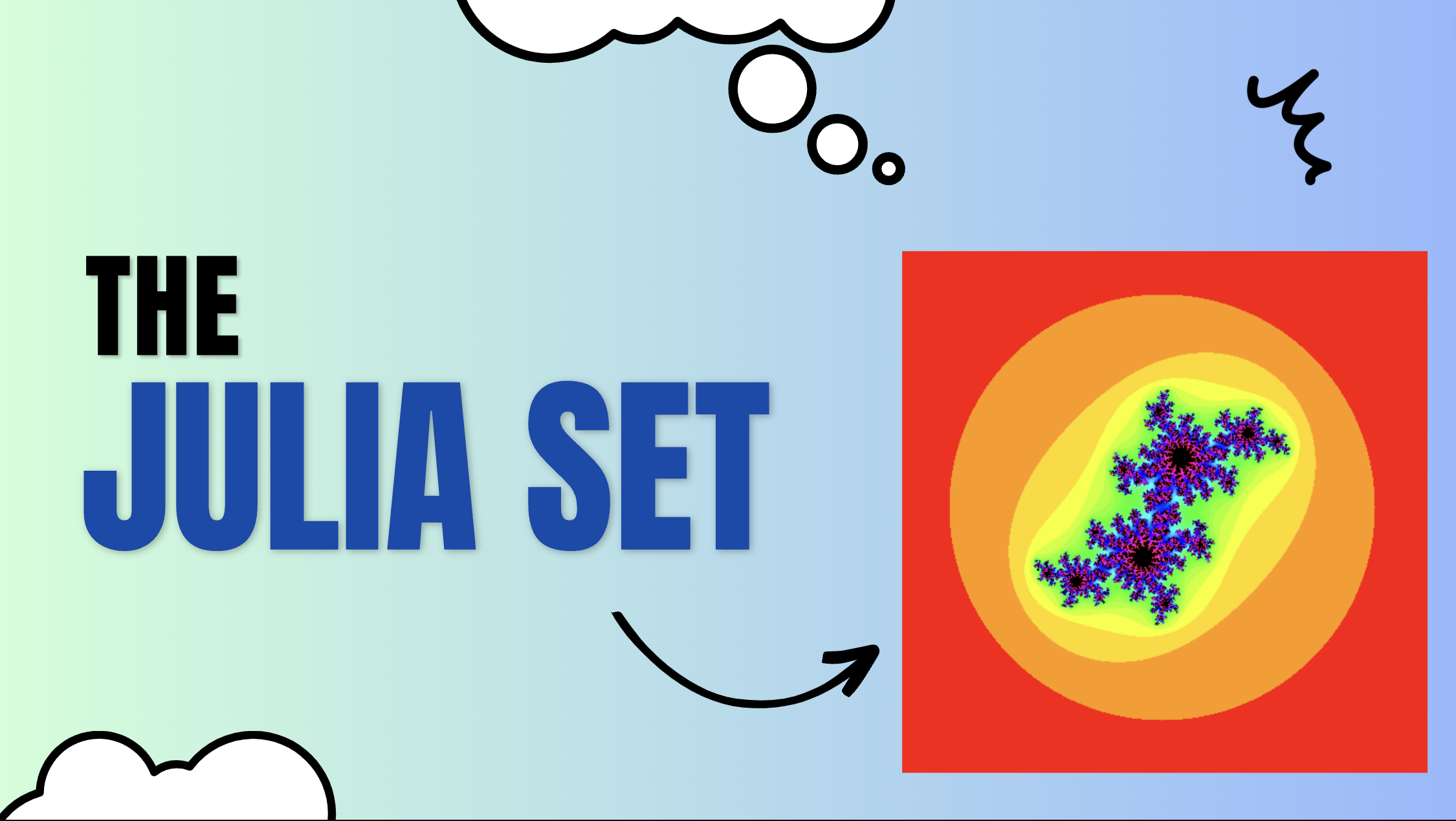
The Julia set and the Mandelbrot set are both fascinating mathematical fractals that are closely related. They share several similarities and are often studied together due to their interconnectedness. Here's a description of the resemblance between the Julia set and the Mandelbrot set:
Both the Julia set and the Mandelbrot set are generated using iterative formulas. The Mandelbrot set is created by iterating the function z(n+1) = z(n)^2 + c, where z is a complex number, and c is a constant complex number that varies for each point in the complex plane. The Julia set is also created using a similar iterative formula, but the constant c remains fixed, while the starting complex number z varies for each point in the complex plane.
The constant C, here is a complex number of the form C = a + bi, where i stands for sqrt(-1). Hence, by changing the combination of value of a and b. we will get various shapes and patterns. These sets are called Julia Set
Here are some of the prominant figures with specific values of C.

The Animation you see is the oscillation of a and b values from -1 to 1. The Oscillation is produced by taking the a = cos(angle) and b = sin(angle). And the angle is between 0 and 2PI.
let angle = 0;
const maxiterations = 100;

const colorsRed = [];
const colorsGreen = [];
const colorsBlue = [];

function setup() {
  pixelDensity(1);
  createCanvas(640, 360);
  colorMode(HSB, 1);

  for (let n = 0; n < maxiterations; n++) {
    let hu = sqrt(n / maxiterations);
    let col = color(hu, 255, 150);
    colorsRed[n] = red(col);
    colorsGreen[n] = green(col);
    colorsBlue[n] = blue(col);
  }
}

function draw() {
  let ca = cos(angle * 3.213);
  let cb = sin(angle);

  angle += 0.001;

  background(255);

  let w = 5;
  let h = (w * height) / width;

  let xmin = -w / 2;
  let ymin = -h / 2;

  loadPixels();

  let xmax = xmin + w;
  let ymax = ymin + h;

  let dx = (xmax - xmin) / width;
  let dy = (ymax - ymin) / height;

  let y = ymin;
  for (let j = 0; j < height; j++) {
    let x = xmin;
    for (let i = 0; i < width; i++) {

      let a = x;
      let b = y;
      let n = 0;
      while (n < maxiterations) {
        let aa = a * a;
        let bb = b * b;

        if (aa + bb > 4.0) {
          break;
        }
        let twoab = 2.0 * a * b;
        a = aa - bb + ca;
        b = twoab + cb;
        n++;
      }

      let pix = (i + j * width) * 4;
      if (n == maxiterations) {
        pixels[pix + 0] = 0;
        pixels[pix + 1] = 0;
        pixels[pix + 2] = 0;
      } else {
        pixels[pix + 0] = colorsRed[n];
        pixels[pix + 1] = colorsGreen[n];
        pixels[pix + 2] = colorsBlue[n];
      }
      x += dx;
    }
    y += dy;
  }
  updatePixels();
}Definition: The Julia set is named after the French mathematician Gaston Julia and was introduced in the early 20th century. It is a set of complex numbers generated by an iterative process based on a fixed complex constant.
Iterative formula: The Julia set is created by iteratively applying a function to a complex number z and observing its behavior. The formula is given by z(n+1) = z(n)^2 + c, where z is a complex number, and c is a fixed complex constant. The iteration starts with an initial value of z, typically chosen from the complex plane.
Membership: Points in the complex plane that remain bounded under iteration are considered to be part of the Julia set. If the values of z grow infinitely large (escape condition), the point is considered to be outside the Julia set.
Connectedness: The Julia set can exhibit various levels of connectedness. Some Julia sets are single connected curves, while others may have multiple disconnected components. The connectedness of the Julia set depends on the value of the constant c.
Parameter space: The Julia set forms a one-dimensional parameter space, with each point in the complex plane representing a different initial value of z. As the value of c varies, the shape and properties of the Julia set change accordingly.
Attractors and Repellors: Within the Julia set, there are points known as "attractors" and "repellors." Attractors are points where the iterative process converges to a specific value, while repellors are points where the process diverges and moves away.
Self-similarity: The Julia set exhibits self-similarity, meaning that zooming in on different regions of the set reveals similar patterns to the overall set. This property is one of the defining characteristics of fractals.
Complexity and Beauty: Julia sets are renowned for their intricate and aesthetically appealing patterns. The complexity of the Julia set increases as you zoom in, revealing an endless array of details and shapes.
Julia Set Fractal Art: Julia sets have inspired artists and mathematicians alike to create beautiful fractal art using computer algorithms. By exploring different values of the constant c, artists can produce a wide range of visually stunning images.
Connection with the Mandelbrot Set: The Julia set and the Mandelbrot set are deeply connected. Each point in the Mandelbrot set corresponds to a different constant c for which the Julia set takes on a unique shape. The Mandelbrot set can be seen as a map of Julia sets.
The Julia set, with its mesmerizing properties and infinite complexity, remains an intriguing topic of study and artistic expression in the realm of fractal geometry and chaos theory.
New tutorials, book updates, and behind-the-scenes notes from the studio. No schedule, no spam.